The Power of Assessment and Formulation
Our rush to escape discomfort
Through the psychology lens and many conversations with professionals in the energy sector, I have been noticing more and more how important it is to take the time to properly time to reflect and understand a situation. And how easily that step can be missed.
When something feels off for instance in our work, we tend to move towards an action to avoid the underlying issue or discomfort, by moving away quickly from the situation e.g. to change job.
But there is a major difference between taking action to escape something, and taking time to move towards something that genuinely attracts you.
If the problem is “this role is not right”, then the solution might appear simple i.e. I need a new role. This initial framing though is usually not complete and tends to overlook more important questions such as: "Why do I need a new role?" and "What can I learn from my current situation?".
What I find interesting too is that for decisions that carry quite a lot of weight like career decisions, we often spend surprisingly little time building that understanding. We can move quickly from noticing something is off to trying to change it, sometimes jumping on the first opportunity that comes.
Learning from the assessment and formulation psychology combination
One distinction that I found particularly helpful in psychology in this initial phase of understanding is the difference between assessment and formulation. Assessment is carried first and is about gathering information; what is happening, what has happened, and what the context looks like.
Then comes the formulation, which is the attempt to connect the different elements and build a “best guess” of how a situation has developed and what might be maintaining it. Not a definitive answer, but a working hypothesis. Something that can evolve over time as new information emerges.
The cycle loop
The way of thinking is often structured as a cycle in psychology. You start by understanding the situation, then make sense of it, before moving into action, and eventually stepping back again to evaluate and refine your understanding.
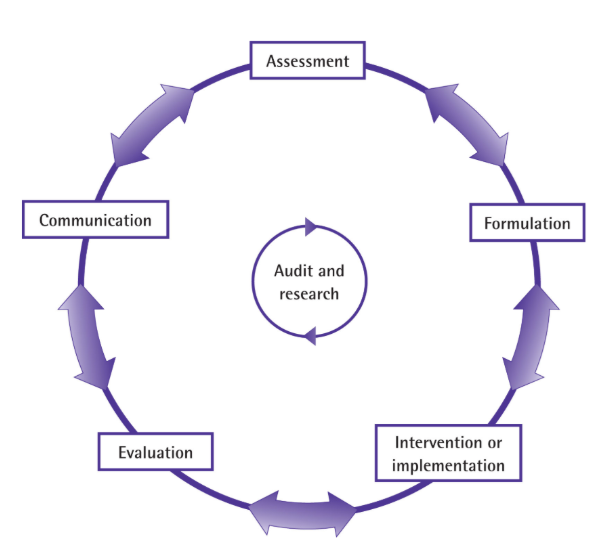
Cycle of Professional Practice - British Psychology Society
What I find interesting is not so much the model itself, but the mindset behind it. The idea that understanding comes before action, and that both evolve over time with a constant feedback loop.
Seeing patterns, not isolated issues
When you start to approach things in this way, it can change how you look at a situation.
Take something like having low energy at work. It can be easy to infer a single cause. The role, the lack of learning, or even specific lifestyle factors like sleep/eating habits. But often, it is not one element on its own; it is how these elements interact.
A role that might be slightly misaligned can feel much heavier for instance when combined with poor sleep. A period of low energy can make a role that would otherwise feel manageable start to feel frustrating. External factors can amplify what is happening at work, and vice versa.
When you start to look at it this way, the question shifts. Not so much “what is the single problem/cause?” But rather “how do these different elements combine to create the experience I am having?”
This is often at that level, in the interaction between different elements, that a clearer understanding begins to emerge.
The idea of “lenses”
Another concept that stayed with me is the idea that there is no single way to understand a situation. In psychology, different approaches and theories offer different “lenses”.
Some focus more on behaviours and patterns. Others on meaning, identity, or past experiences. Others on context and relationships. Each lens highlights certain aspects and leaves others in the background.
Which means that how we interpret a situation depends, at least partly, on the lens we are using.
A familiar way of thinking
In many ways, this is not so different from how we can approach projects in professional work; projects usually start with an initial phase of understanding, and with the need to clarify the scope.
We then take time to understand what is actually being asked, what the core issues are, what a good outcome would look like, and what success means in that specific situation.
From there, we start shaping an approach. We recognise that there are different ways, or “lenses”, to approach the problem.
At the same time, we need stay aware of the limitations. What we might be missing, what assumptions we are making, what risks could emerge, and how they might be mitigated. The first approach is only a starting point, something to test, adjust, and refine as we go.
In many cases, truly understanding the client’s needs and shaping the right approach, is the hardest part of the work. Once that is clear enough, a large part of the work is already done.
And yet, when it comes to our own careers, we often move much faster. We notice something is off, and we go straight to the action, without always taking the time to build that initial understanding.
From understanding to decision
None of this removes the need to decide. At some point, a direction has to be chosen, with the trade-offs that come with it.
But there is a difference between making a decision to quickly move away from discomfort, and making one based on a clearer understanding of what is actually happening. The second does not make decisions easier, but it makes them more intentional.
Final reflection
Before thinking about what you should do next, you could take a step back and try to understand your situation a bit more fully. Gathering the different elements, looking at the context, and forming a “best guess” of how things have developed and what might be maintaining them. In psychology, this would be called assessment and formulation.
But it is easier said than done. It is not how we naturally tend to think about our own situations. And even if we do, it is not always easy to create the space for it, to step back, reflect, and not get pulled back into day-to-day demands or distractions.
Which is often why having a conversation can help. Not to give simple answers, but to create that space and think things through more clearly. And if this is something you would like to explore further, I would be glad to exchange perspectives.
Thank you for taking the time to read.